1st Amendment, 1; Sanity, 0


posted by Lance @ 9:49 AM
0 comments


A blog about life, language, writing, and other trivia.
I'm a husband, a father, and an English professor with a specialization in Writing Studies. I love spending time at home, writing, and thinking about big questions having to do with writing and language.


Subscribe to
Posts [Atom]
I found the "Officer Down Memorial Page"--and specifically this entry on Pierce City, Missouri police officer R.J. Chappell--after doing some research to find out more about the Pierce City race-cleansing of 1901, in which a gun-toting, torch-wielding mob drove around 200 blacks out of town. In the process, the mob killed three black residents of Pierce City and attempted to kill many more, after the alleged murder of a white woman by a black man.

posted by Lance @ 1:49 PM
0 comments
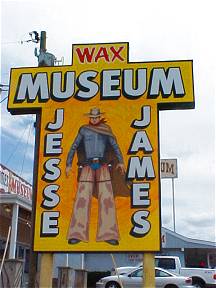
Snapped a block from my mother's house on our way back to Ohio after Christmas in Springfield, Mo:

posted by Lance @ 10:34 AM
0 comments
Like many of my colleagues in Rhetoric, Composition, and Writing Studies, I come originally from a small city (or if you prefer, a large town) full of red-blooded Americans and even redder politics. Springfield, Mo. is the seat of the national headquarters of the Assemblies of God and is John Ashcroft's home town. It also produced the late Payne Stewart, who at the height of his career, and just before his death, could always be seen wearing his "WWJD" bracelet during golf tournaments (and presumably everywhere else). There was a triple lynching on the town square in 1906, its schools weren't desegregated until they were forced to by Brown v. Board of Education, and in the 1980's protestors apparently burned the residence of an MSU (then SMSU) student starring in a "controversial" play about AIDS. And while Springfield has its share of progressives (it's also home to Missouri State University), the town's conservative fundamentalist roots are strong and powerful.
Labels: AIDS, conservatism, family, Missouri, social justice
posted by Lance @ 7:47 PM
0 comments
In lieu of a new post, I'll just link to an old one. The only differences this time: my mom's knee is better, and we'll be coming back to Ohio (via Chicago) with patio furniture.
posted by Lance @ 11:47 PM
2 comments